Introduction
If you have spent any time sourcing products from China, you have almost certainly encountered the terms OEM and ODM. These two manufacturing models are the backbone of global supply chains — from consumer electronics and automotive components to precision metal parts and construction hardware.
Yet many buyers still confuse the two, or worse, choose the wrong model for their project. The consequences can be significant: unexpected costs, delayed timelines, quality inconsistencies, or intellectual property disputes.
This article provides a clear, practical breakdown of OEM vs ODM manufacturing, including real-world examples, cost comparisons, and guidance on choosing the right approach for your specific needs. Whether you are launching a new product line or sourcing custom metal parts, this guide will help you make an informed decision.
What Is OEM Manufacturing?
OEM stands for Original Equipment Manufacturer. In this model, the buyer provides the product design — including engineering drawings, material specifications, and quality requirements — and the manufacturer produces the parts exactly to those specifications.
How OEM Works
- The buyer designs the product — You (or your engineering team) create detailed CAD drawings, specify materials, tolerances, surface treatments, and performance requirements.
- The manufacturer produces to spec — The factory uses your design files to set up tooling, program CNC machines, and manufacture parts that match your exact specifications.
- Quality is verified against your standards — Every batch is inspected according to your quality criteria, typically with First Article Inspection (FAI) reports and dimensional check reports.
Key Characteristics of OEM
| Feature | Description |
|---|---|
| Design ownership | Belongs to the buyer |
| Intellectual property | Protected by NDA and contract |
| Customization level | Full — every detail is controlled by the buyer |
| Tooling cost | Paid by the buyer (higher upfront investment) |
| Unit cost | Lower at higher volumes |
| Lead time | Longer for initial setup, shorter for repeat orders |
| Best for | Unique products, proprietary designs, precision parts |
OEM in CNC Machining: A Practical Example
Consider a European automotive parts distributor that needs custom brake caliper brackets made from stainless steel 316L. The distributor’s engineering team provides:
- 3D CAD files in STEP format with all critical dimensions
- Material specification: SUS316L, ASTM A240 compliant
- Tolerance requirements: ±0.02mm on mounting holes, ±0.05mm on general dimensions
- Surface treatment: Passivation per ASTM A967
- Quantity: 5,000 pieces per order, with annual demand of 20,000 units
The CNC machining manufacturer (OEM) reviews the drawings, confirms manufacturability, quotes a price, and produces the parts exactly as specified. The design and IP remain with the buyer.
What Is ODM Manufacturing?
ODM stands for Original Design Manufacturer. In this model, the factory already has its own product designs and can manufacture and brand them according to the buyer’s requirements.
How ODM Works
- The factory has existing designs — The manufacturer has already developed product designs, built tooling, and established production processes.
- The buyer selects and customizes — You choose from the manufacturer’s existing product catalog and request modifications (such as different materials, colors, dimensions, or branding).
- The factory produces and ships — The manufacturer handles production using their existing tooling and processes, with your customizations applied.
Key Characteristics of ODM
| Feature | Description |
|---|---|
| Design ownership | Belongs to the manufacturer |
| Intellectual property | Shared or manufacturer-owned (customizations may vary) |
| Customization level | Limited — can modify existing designs but not create from scratch |
| Tooling cost | Already paid by the manufacturer (lower upfront investment) |
| Unit cost | Lower at small to medium volumes |
| Lead time | Shorter — production processes are already established |
| Best for | Private label products, white-label goods, fast market entry |
ODM in Practice: A Practical Example
Imagine a hardware retailer in the Middle East that wants to sell architectural brackets under their own brand. Instead of designing brackets from scratch, they partner with an ODM manufacturer who already produces a range of standard steel brackets. The retailer selects three models, requests custom packaging with their logo, and specifies a black powder coating finish. The manufacturer produces and ships the branded products within weeks — no design engineering required.
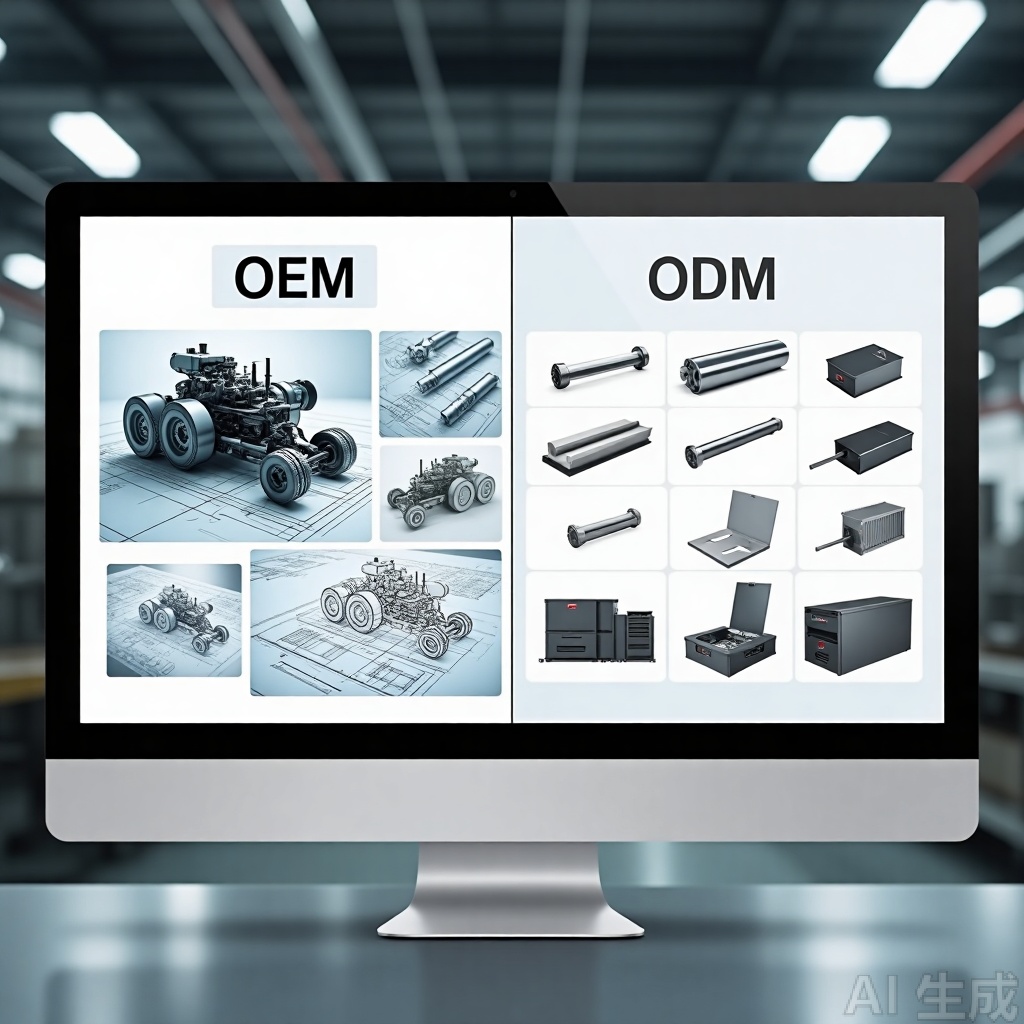
OEM vs ODM: Side-by-Side Comparison
The table below summarizes the most important differences between the two manufacturing models:
| Comparison Factor | OEM | ODM |
|---|---|---|
| Who designs the product? | Buyer | Manufacturer |
| Design flexibility | Unlimited | Limited to existing designs |
| IP ownership | Buyer | Manufacturer |
| Upfront investment | Higher (tooling, engineering) | Lower (tooling exists) |
| Time to market | Longer (design + setup phase) | Shorter (ready to produce) |
| Unit cost at low volume | Higher | Lower |
| Unit cost at high volume | Lower (economies of scale) | Moderate |
| Quality control | Buyer defines standards | Manufacturer defines standards |
| Exclusivity | Can be exclusive | Usually not exclusive |
| Minimum order quantity | Typically higher | Often lower |
| Best suited for | Proprietary products, precision parts | Private label, fast launch |
Which Manufacturing Model Should You Choose?
The right choice depends on your specific situation. Here are the most common scenarios:
Choose OEM When:
- You have your own product design — If your engineering team has developed proprietary designs with specific performance requirements, OEM is the only option that gives you full control.
- You need precision CNC machined parts — Custom metal parts with tight tolerances, specific material grades, and complex geometries are typically produced under OEM arrangements.
- Intellectual property protection is critical — If your design is a competitive advantage, you need the IP ownership and NDA protection that OEM provides.
- You have higher volume requirements — OEM becomes more cost-effective as volumes increase, since tooling costs are amortized over larger production runs.
- You need strict quality standards — OEM allows you to define every quality parameter, from material certificates to inspection protocols.
Choose ODM When:
- You want to launch quickly — ODM products are already designed and tooled, dramatically reducing time to market.
- You have limited engineering resources — If you do not have an in-house design team, ODM lets you leverage the manufacturer’s existing product expertise.
- Your budget is limited — Without tooling costs and design engineering fees, ODM requires a smaller upfront investment.
- You are building a private label brand — If your competitive advantage is in marketing and distribution rather than product design, ODM is a practical choice.
- You are testing a new market — ODM allows you to test market demand with lower financial risk before committing to custom OEM production.
The Hybrid Approach: OEM + ODM
Many successful companies use both models simultaneously. For example:
- An industrial equipment company might use OEM for custom-engineered CNC components that are proprietary to their machines, while sourcing ODM for standard fasteners, brackets, and packaging materials.
- A consumer goods brand might start with ODM to quickly test market demand, then transition to OEM as they develop proprietary designs and build volume.
This hybrid approach lets you optimize cost, speed, and quality across your entire product portfolio.
How to Work with a Chinese OEM/ODM Manufacturer
Whether you choose OEM or ODM, working with a Chinese manufacturer requires careful preparation. Here is a practical checklist:
Before You Contact a Supplier
- Define your requirements clearly — Prepare detailed specifications including dimensions, materials, tolerances, surface treatments, quantity, and delivery timeline.
- Prepare your design files — CAD drawings in STEP or IGES format are standard for CNC machining projects.
- Know your budget range — Having a target price helps the manufacturer suggest the most cost-effective approach.
- Check relevant certifications — If your industry requires specific standards (ISO 9001, IATF 16949, AS9100), make sure the supplier holds them.
During the Supplier Selection Process
- Request quotes from multiple suppliers — Get at least 3 quotes to establish a price baseline.
- Ask for factory audit reports — Third-party audit reports from SGS, TüV, or Bureau Veritas provide independent verification.
- Sign an NDA before sharing designs — This is especially critical for OEM projects with proprietary designs.
- Request samples before mass production — Always verify quality with physical samples before committing to large orders.
During Production
- Communicate regularly — Request progress updates and photos during production.
- Consider a pre-shipment inspection — For large orders, a third-party inspection before shipping can catch quality issues early.
- Document everything — Keep records of all specifications, change orders, quality reports, and shipping details.
Common Mistakes When Choosing Between OEM and ODM
After years of working with global clients, we have seen these mistakes repeated frequently:
1. Choosing ODM When You Actually Need OEM
If your product has unique performance requirements or proprietary features, forcing it into an ODM mold will compromise quality and functionality. Custom CNC machined parts with tight tolerances almost always require OEM manufacturing.
2. Assuming ODM Means Lower Quality
This is a misconception. Many ODM manufacturers produce high-quality products for well-known global brands. The key is selecting the right manufacturing partner and clearly defining your quality standards.
3. Neglecting IP Protection in OEM Arrangements
Even with an NDA, you should take additional steps to protect your intellectual property:
- Register patents and design rights in your target markets before sharing designs
- Split manufacturing across multiple suppliers for sensitive components
- Use encrypted file transfer methods for CAD drawings
- Avoid sharing complete assembly drawings — share only individual part drawings
4. Not Clarifying Payment Terms
OEM projects often require tooling deposits and milestone payments. ODM projects typically follow standard payment terms (e.g., 30% deposit, 70% before shipment). Clarify payment terms before placing any order.
5. Skipping the Sample Phase
Whether OEM or ODM, always start with samples. This single step prevents the vast majority of quality disputes and costly rework.
Cost Comparison: OEM vs ODM
Understanding the cost structure of each model helps you budget accurately:
| Cost Component | OEM | ODM |
|---|---|---|
| Design engineering | $500–$5,000+ (one-time) | $0 (included) |
| Tooling setup | $1,000–$50,000+ (varies by complexity) | $0 (already exists) |
| Per-unit cost (100 pcs) | Higher | Lower |
| Per-unit cost (10,000 pcs) | Lower | Moderate |
| Quality inspection | Buyer-specified (additional cost possible) | Manufacturer standard |
| Packaging customization | Fully custom | Limited options |
| Total upfront investment | High | Low |
| Long-term cost at scale | Lower | Moderate |
Note: These ranges are indicative and vary significantly based on part complexity, material, precision requirements, and order volume. Contact a manufacturer for a detailed quote specific to your project.
Why Avada Tools Is Your Trusted Manufacturing Partner
At Avada Tools, we support both OEM and ODM manufacturing models, giving you the flexibility to choose the approach that best fits your project.
As an ISO 9001-certified CNC machining manufacturer based in Yongkang, Zhejiang, China, we offer:
- OEM services — Full custom manufacturing from your CAD drawings, with tolerances up to ±0.01mm, CMM inspection, and complete material traceability
- ODM solutions — Leveraging our extensive product catalog and manufacturing expertise for clients who need faster time to market
- Hybrid support — Many of our clients use us for custom OEM components alongside standard parts from our existing product lines
- Complete transparency — Detailed quotes, progress photos, FAI reports, and open communication throughout every project
Since 2012, we have served OEM and ODM clients across North America, Europe, the Middle East, and Southeast Asia — from prototype quantities of 10 pieces to production runs exceeding 100,000 units.
Conclusion
The difference between OEM and ODM manufacturing comes down to who owns the design and how much control you need over the final product. OEM gives you full design control, IP ownership, and customization — ideal for proprietary products and precision CNC parts. ODM offers faster launch, lower upfront costs, and simplified sourcing — ideal for private label brands and market testing.
Many businesses use both models strategically. The key is matching the right model to each product in your portfolio, working with a reliable manufacturing partner, and maintaining clear communication throughout the process.
Ready to discuss your manufacturing project? Our engineering team reviews every inquiry within 24 hours and provides detailed technical feedback alongside competitive pricing.
about
avada factory
Avada Tools is an ISO 9001-certified CNC machining manufacturer based in Yongkang, China. Since 2012, we have delivered precision custom metal parts and manufacturing solutions to clients across 40+ countries worldwide.